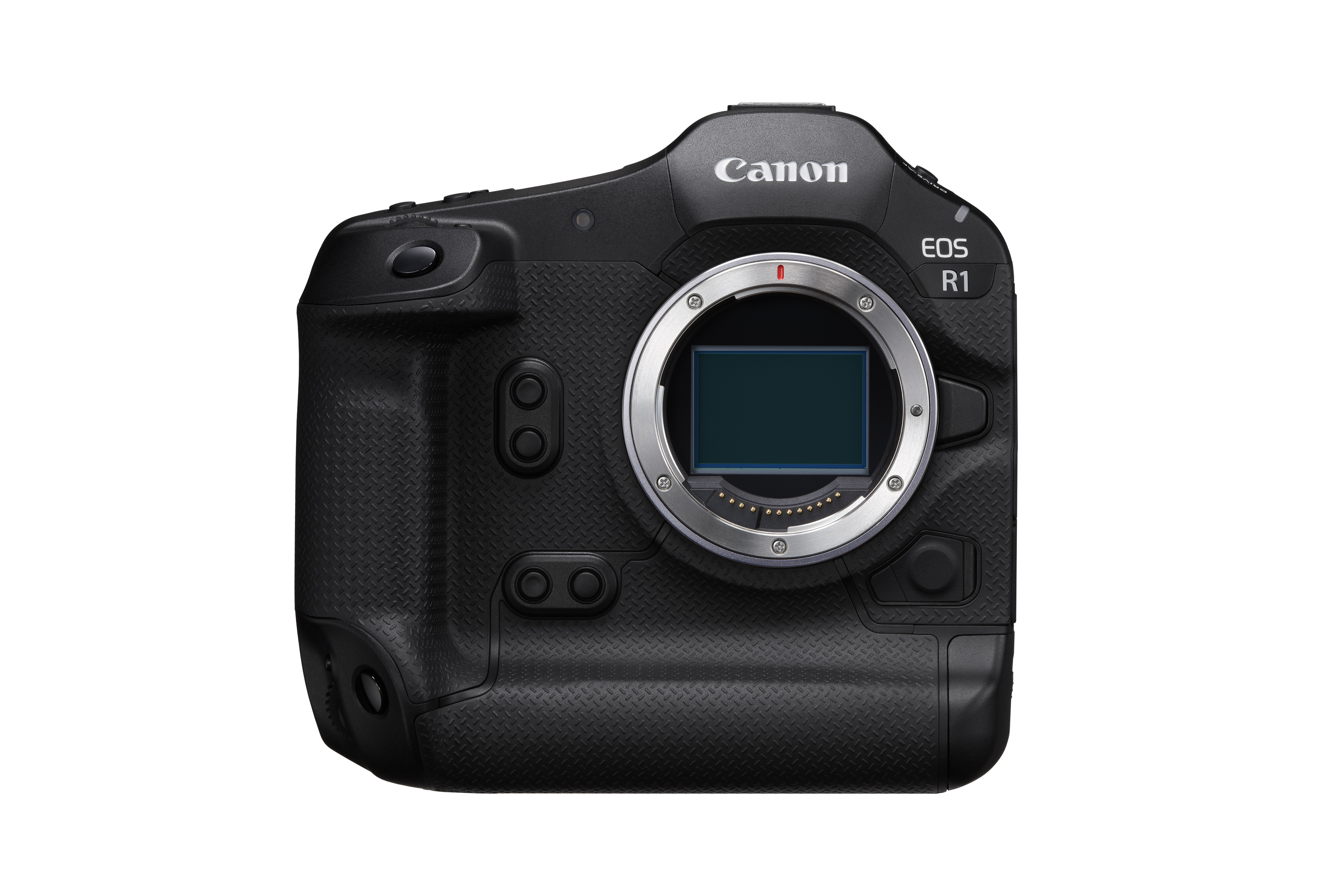
Canon EOS R1

The EOS R1 — Be ONE with Mastery

The new mirrorless full-frame flagship of the EOS R System — surpasses the imagination for professionals who need absolute precision, speed and reliable operability out in the field of action photography. Blaze your way through with up to 40 fps continuous shooting on the EOS R1, the flagship of the full-frame mirrorless R-series, which features Dual Pixel Intelligent AF that keeps your subject focused no matter the situation. With the In-camera Upscaling and Neural Network Noise Reduction feature, you can get clean images with a resolution of approximately 96MP even when shooting at ISO102,400.

Record breathtaking videos with the high detail 6K 60p RAW or videos up to 5x slower for that slow-mo cinematic effect with the 4K 120p.
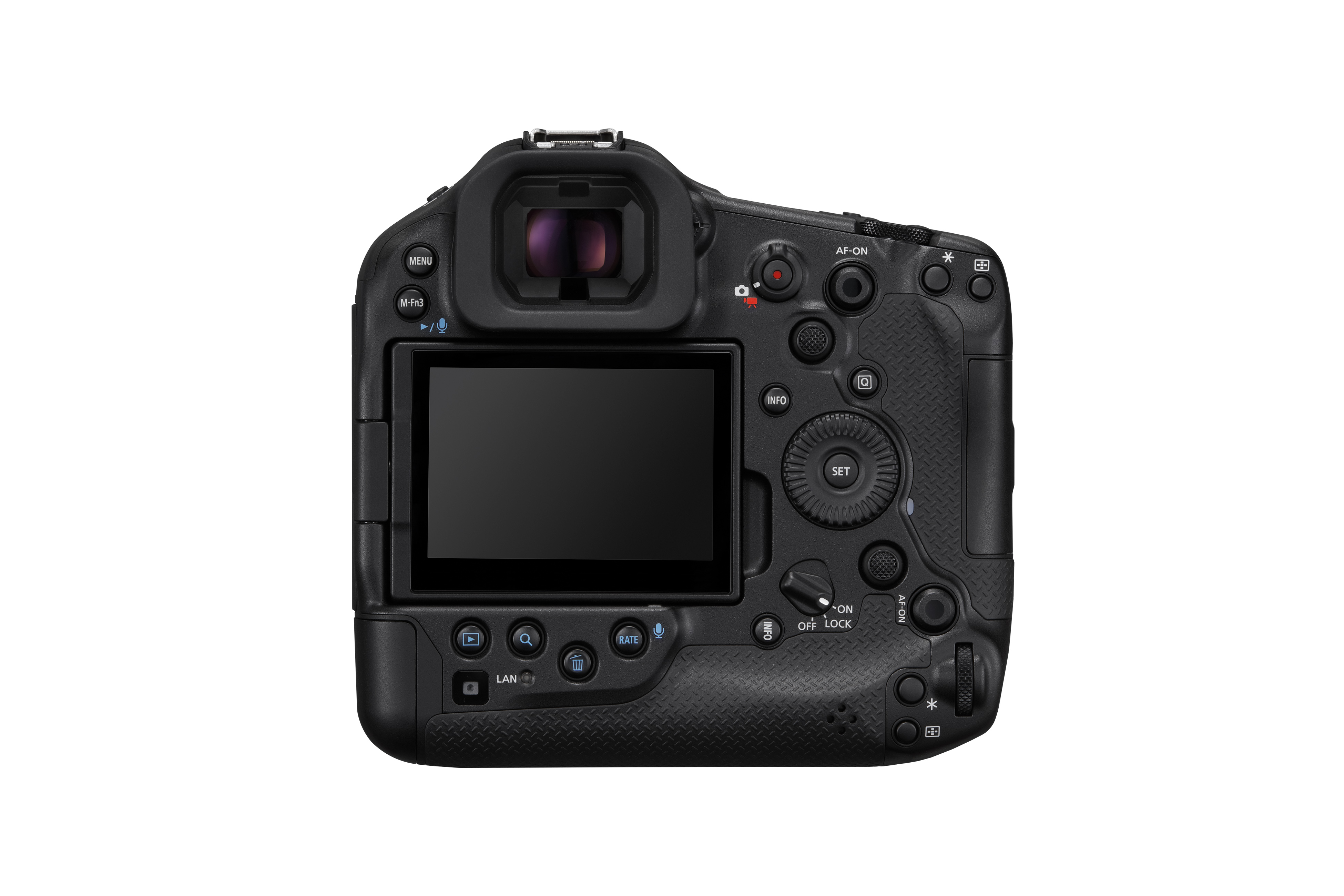
Powerful Image Processing System

High speed and sensitivity that lets you capture every critical action with
outstanding clarity. The advanced DIGIC X image processor, DIGIC Accelerator and new full-frame back-illuminated stacked CMOS sensor from the Accelerated Capture system,
which combines with Deep Learning technology to enable In-camera Upscaling and Neural Network Noise Reduction.

Deep Learning Technology

The EOS R1 leverages on Deep Learning with complex neural networks and advanced algorithms. Together with the Accelerated Capture System and the new Dual Pixel Intelligent AF, this results in groundbreaking improvements in AF recognition and speed, noise reduction, in-camera upscaling, and more accurate auto exposure and white balance.

Key specifications

  • 24.2MP Stacked CMOS Dual Pixel sensor
  • 100% AF coverage with cross-type sensors
  • Up to 40fps blackout-free shooting (JPEG+Raw)
  • Pre-capture for photo and video (1/2 sec. for photos, 3 or 5 sec for video)
  • Eye-controlled AF with improved eye detection
  • AI-trained Autofocus and post-shot processing modes
  • 6K/60p internal Raw video capture
  • DCI-4K capture up to 120fps
  • Canon C-Log2 gamma profile
  • Wi-Fi 6E and Ethernet connectivity

Sensor

Designed with speed in mind, the new full-frame back-illuminated stacked CMOS sensor in the EOS R1 offers 24.2 effective megapixels and up to ISO 102,400. The new stacked architecture enables ultrafast data processing speeds which photographers require when documenting fast action in the field.

In addition to the faster speed, the R1’s sensor also includes 100% AF coverage with cross-type sensors. This is accomplished by rotating every other line of the sensor’s dual-pixel PDAF pixels 90º to create PDAF zones sensitive to horizontal lines as well as vertical. Cross-type autofocus works in photo mode only and does not work under certain conditions, such as flickering light sources.

New Digic accelerator

The EOS R1 uses Canon’s Digic X processor along with a new Digic Accelerator co-processor. Canon claims this co-processor is the key to the camera’s improved autofocus features, particularly those using AI features derived from machine learning.

The result is that the camera can do more than identify a subject; in certain situations, it can identify a subject, such as a person, and determine what type of action that person is performing, such as a basketball player driving to the basket with the ball. This allows the camera to prioritize and maintain focus on the most important subject in a scene.


Blackout-Free Shooting and High-Speed EVF Display

Frame, track and compose your shots without losing sight of fast-moving subjects. The EOS R1’s high-speed readout and image processing, coupled with a blackout-free Electronic Viewfinder (EVF) enables you to capture every key moment with no interruption.
The EOS R1 EVF refreshes at up to 120 FPS to display smooth subject movement with no time lag. The new sensor delivers up to 40fps blackout-free continuous shooting in 14-bit mode.


High-Speed Continous Shooting – 40FPS

Nail every action as it unfolds. The advancement in electronic shutter sees a max. speed of 40 FPS*1. Toggle through various intermediate shooting speed settings for even more shooting flexibility. In any shutter mode, the advanced EOS iTR AF X ensures focus is always spot on, allowing you to concentrate on your composition.


Minimal Rolling Shutter Distortion

Along with the high shooting speed, the new CMOS sensor and highspeed image processing system enables the EOS R1 to capture images with minimal rolling shutter distortion, on par with the EOS-1D X Mark III mechanical shutter.

Silent Shutter

More discretion where required. Shoot silently even at 40 FPS burst shooting to reduce unwanted noise when photographing wildlife or indoor performances where any sound can be distracting.

Wider Choice of Shooting Speeds

Select from a range of shooting speeds* for greater flexibility based on photography needs.

Autofocus – Dual Pixel Intelligent AF with Cross Type AF

A first for Dual Pixel CMOS AF, the EOS R1 features a Cross-type AF tracking of up to 100% of the sensor area*1. This improves AF reliability and stability, especially on subjects affected by patterns and obstructions such as horizontal lines.

The newly developed compact optics and line-of-sight sensor in the EOS R1 consist an approx. 307,000 pixels that accurately detect your eye movements. The high pixel count allows you to shift focus intuitively between multiple fast-moving subjects*2 accurately without
having to look away from the EVF or manually select the focus zones.

Eye Controlled AF

The EOS R1 receives an updated version of the eye-controlled AF system found on the EOS R3. (Which is a modernized version of the system found on some of Canon’s EOS film cameras from the 1990s and 2000s). With eye-controlled focus, the camera moves a focus target around the viewfinder by following your eye. Once this target is close to your intended subject, initiating autofocus will trigger the camera to lock onto the most likely subject and continue tracking it.

Eye-controlled autofocus has been a polarizing feature on previous EOS models because it hasn’t worked well for all users, but Canon hopes to change that. On the R1 (and R5 II), the system has a wider field of view to better track your eye, which results in an expanded viewfinder area and larger eye cup. Additionally, new compact optics and a revised line-of-sight detection algorithm mean your eye can be approximately twice as far away from the EVF and still work. The updated system also includes eyeglass detection, which should improve performance for glasses wearers.

Action Priority AF Mode

Another important new feature is Action Priority AF mode. This mode uses machine learning technology to analyze a scene and attempt to predict the most important subject(s) based on the context of the scene. For example, when shooting basketball, the AF system will generally attempt to stick with the player with the ball, even if that person crosses paths with similar-looking players. If the player passes the ball, the system will know to re-prioritize AF on the player who receives it.

Action Priority AF mode is currently trained on football (soccer), basketball and volleyball. A Canon representative hinted that additional sports might be added in the future.

Pre-continous shooting mode

At half-press of the shutter button, the EOS R1 buffers up to 20 frames before a full press, ensuring you capture crucial moments even after a late capture. Together with Action Priority AF and Register People Priority, havea peace of mind capturing fast subjects with lesser chance of missing shots. All image formats such as RAW/C-RAW/HEIF/JPEG can be selected for precontinuous shooting.

Register People Priority

Detect specific people for tracking by registering their faces in advance for constant tracking performance. With Deep Learning, store up to 100 faces*1 in the EOS R1 and select the specific individuals to prioritise tracking automatically.

Powerful Image Stabilisation

EOS R1 comes with a built-in 5-axis In-body Image Stabilizer. Every lens1 you own will benefit from improved low-light capablities, steadier video recording, and sharper photos. Combined with the lens’s Optical Image Stabilizer, you can get up to 8.52 stops of image stabilisation, ideal for low-light handheld shooting, super-telephoto and long exposure photography,

Shutter Durability

With the EOS R1’s exceptional shutter mechanism, which can withstand up to 500,000 cycles, you can shoot those rapid-fire photos with confidence.

You can adjust for the shutter curtain to close when turning off the camera, keeping dust out. It can also be left open if you want to power up the camera quietly.

Dual Card Slots

With dual card slots that accommodate two CFexpress Type B cards*, the EOS R1 doubles your memory capacity.

The slots can be used for simultaneous backup, primary and proxy video recordings, and for separate recording of video and photos.

*Supports up to 2TB size

Strong & Durable – Magnesium Alloy Chassis

Pro-oriented build quality and high reliability. The EOS R1’s robust chassis is highly impact resistant and offers outstanding electromagnetic shielding properties. The rigid and lightweight design also provides efficient heat dissipation during long shoots by transferring heat generated internally outwards to the magnesium body.

Dust and Water Resistance – Weather Sealing

The EOS R1 uses sealing materials for connecting parts. In addition to that, silicone boots around buttons and o-rings around dials, levels, and other moving parts further enhance the dust- and drip-resistance. The sealing materials are checked with 3D scans and X-rays to ensure the camera is properly protected.


Wireless Connectivity

WiFi 6E Support – A first in the EOS R series, the EOS R1 comes with standard 5 GHz/2.4 GHz support for a range of fast file transfer speeds to devices, PCs, FTP or the new Content Transfer Professional app. You can also easily connect to the Canon Camera Connect app via Bluetooth Low Energy (2.4 GHz).

Bluetooth Low Energy (2.4GHz) – Register up to 25 devices with the EOS R1 for even greater usability and convenience. Capture scenes remotely through the Canon Connect app on your smartphone*1, or pair it with the BR-E1 wireless remote controller for both continuous and dual shooting.

Image.canon App – Elevate your workflow through the cloud. Your content can be uploaded
and downloaded from your computer offsite, and is automatically sorted between photo and video files — photos are uploaded to Adobe Lightroom or Google Photos, while videos are uploaded to Frame.io. Edit and collaborate seamlessly on the go in real time.


Source:

Canon MalaysiaMirrorless (EOS R) – EOS R1 (Body) – Canon Malaysia

DPreviewhttps://www.dpreview.com/reviews/canon-eos-r1-initial-review


Canon EF 70-200mm f/2.8 L IS II USM Lens Review

IMG_1055 (1280x841)

Source: The-Digital-Picture.com & dpreview.com

Specifications:

  • High-performance, L-series telephoto zoom lens
  • Constant maximum aperture of f/2.8
  • Four-stop Image Stabilizer
  • Fluorite and UD lens elements
  • Improved durability
  • 1.2m minimum focusing
  • Water and dust resistant
  • Ring type USM AF motor
  • Rounded 8-blade aperture

The Canon EF 70-200mm f/2.8 L IS II USM Lens delivers exceptional image quality, focuses accurately very fast and has superb build quality, 4-stop Image Stabilization, weather sealing and a very useful focal length.

The Canon EF 70-200mm f/2.8 L IS II USM Lens is now my favorite and most used lens for weddings and Portraits. With a rounded 8-blade aperture, the Canon EF 70-200mm f/2.8 L IS II USM Lens delivers impressive bokeh, which was very good in this respect. With an f/2.8 maximum aperture over the entire telephoto focal length range, this lens is able to create a strongly blurred background and provides a bright viewfinder.

IMG_1073 (852x1280)

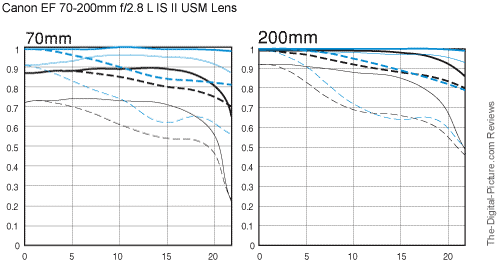
As you can see below , the higher the lines in a Canon MTF chart, the better the lens can be expected to perform optically. The Canon MTF chart comparison below shows an expected noticeable wide open aperture image quality improvement in the new lens.

m

The Canon EF 70-200mm f/2.8 L IS II USM Lens’ real world image quality and image quality improvement over the original version are impressive. The 70-200 f/2.8 IS II is very sharp wide open from the center of the image circle right into full frame corners at all focal lengths.The with-extender tests at 280mm and 400mm confirm this of course. Contrast is especially impressive from this lens – a noticeable improvement over the version 1 lens. Stopping down increases sharpness.

IMG_1224 (853x1280)

The Canon EF 70-200mm f/2.8 L IS II USM Lens is my first choice portrait lens. Full frame body owners will find the 70-200mm focal length range will allow full body portraits to tight head shots – and the improved MFD is especially noticeable when shooting full frame head shots. With IS, careful framing and low light shooting is easy.

With a wide f/2.8 aperture, fast AF and excellent wide open image quality, the Canon EF 70-200mm f/2.8 L IS II USM Lens is a great sports lens. Watch the pro photographers on the sidelines of your favorite sports event – most have a 70-200 f/2.8 hanging over their shoulder even if they are using one of the big guns as their primary lens. The 70-200 IS II frames sports figures best on large fields (soccer, baseball …) when used on an APS-C/1.6x body. An f/2.8 lens is marginal for stopping indoor sports action, but it will get the job done – especially if you have one of the latest DSLRs with great high ISO capabilities.

IMG_1066 (951x1280)

Conclusion

  • Excellent wide open image quality
  • Superb Build Quality
  • Blistering Fast Autofocus Speed
  • Excellent for Wedding and Portraits Photographers
  • Good for Professional Photographers Who demands for Exceptional image Quality
  • Canon Updated the Image Stabilization to 4 Stops which will be very useful for Portraits & Wildlife Photographers

conculsion

For more information on Inquiry & Packages,
Please Contact : +6012-2230215
Email: Haridra_Image@yahoo.com

All Images are Copyright © 2013 Haridra-Image Photography

Canon EOS 5D Mark III Review

canon_eos_5d_mark_iii_black


The Canon 5D Mark III is the Best DSLR for Wedding Photography , packed with Awesome features

Source: techradar.com & dpreview.com

Key Features:

5D Mark III Key Features

22.3-megapixel, full-frame (36.0mm x 24.0mm) CMOS Sensor

61-Point high-density reticular AF, 41 cross-type and 5 Dual cross-type points with customizable AF presets featuring from Canon’s revolutionary EOS-1D X

Up to 6fps continuous shooting

63-Zone iFCL Dual Layer Metering Sensor

Newly designed shutter is equally as durable and has been tested up to 150,000 cycles

Intelligent Viewfinder – Provides 100% field of view with 0.71x magnification

Native ISO 100-25,600 sensitivity & 102,400 (expanded)

Full HD video 1080p (24/25/30 fps), 720p (24/25/30/50/60 fps)

New 14-bit DIGIC 5+ Processor from Canon’s revolutionary EOS-1D X

Rugged Magnesium Alloy Body with Enhanced Weather sealing

More Rounded Improving Grip Holding

Multiple Exposure and High Dynamic Range (HDR) mode with presets

Dual CF and SD Memory Cards Slots

Clear View LCD Display Featuring 1.04-million dot, 3.2-inch (8.11cm)

Dual Axis Electronic Level

Max Image Size 5,784 x 3,856 pixels

New Rate Button

Optional Battery Grip BG-E11 – Features buttons and a multi-controller.

eos_5d_mark_iii

“The EOS 5D Mark III represents a big step forward for the EOS 5D series” – Source from Canon Europe. “The EOS 5D Mark II is an exceptional camera and we’ve listened carefully to feedback from its passionate community of users to improve performance in every area. This camera has been designed to meet virtually any creative challenge – it’s faster, more responsive and features the tools to adapt to everything from studio photography to creative videography, while producing results of the highest quality.”


Enhanced performance

With its comprehensively upgraded specification, the EOS 5D Mark III is the ideal tool for the growing number of photographers shooting both stills and movies. It incorporates a number of the features launched with Canon’s revolutionary EOS-1D X, providing vastly improved performance, flexibility, handling and durability.

The camera’s newly-developed 22.3MP full-frame sensor provides increased resolution and finer detail, enabling the capture of a wide range of scenes, from sweeping landscapes to beautiful portraits. Higher speed continuous shooting also offers expanded creative possibilities. With an increased 8-channel read out, the camera comfortably handles a maximum full resolution speed of up to 6fps in bursts of 18 RAW images or over 16,000 JPEG’s, without the need for additional accessories. Additionally, the sensor’s advanced architecture offers a huge native ISO range of 100-25,600, expandable to 102,400, making it possible to capture clean, high quality pictures, even in extreme low-light conditions.

The EOS 5D Mark III utilizes the same 61-point wide-area AF system as the flagship EOS-1D X, providing exceptional sensitivity, precision and speed. One of the most advanced AF systems currently available, it features an impressive 41 cross-type points and five dual cross-type points, providing unsurpassed accuracy across the frame. The customizable AF pre-sets introduced in the EOS-1D X are also available, helping the capture of traditionally challenging subjects, and providing additional reliability in situations where subject movement can be unpredictable.

Highly accurate exposures are provided by Canon’s acclaimed iFCL metering system, which incorporates a 63-zone Dual-Layer sensor linked to each point of the AF system. Focus information gathered from the AF system is analyzed alongside color and luminance signals measured by the metering sensor itself, enabling the EOS 5D Mark III to deliver consistently accurate skin tones and excellent results in a wide range of shooting situations.

Creative performance without compromise

The EOS 5D Mark III features Canon’s latest DIGIC 5+ image processor, which powers a range of new functions without affecting the camera’s performance. 14-bit A/D conversion provides smoother tonal gradation and transitions between colors, while in-camera HDR shooting combines three different exposures and allows one of five preset tone maps to be applied, enabling photographers to capture all the detail in high contrast scenes. With in-camera RAW processing and editing capability, photographers also have the option to immediately begin post-processing their images while still on a shoot.

The increased power of DIGIC 5+ also enables a range of tools which contribute to higher image quality. Lens peripheral illumination correction, Lens chromatic aberration correction (lateral and axial) and high ISO noise reduction are all performed in-camera without affecting performance, allowing photographers to continue shooting without any camera lag. Additionally, in-camera image rating via a dedicated button makes it easy for photographers to organize images ahead of post-production.

The EOS 5D Mark III features a new Creative Photo button, which enables users to quickly select Picture Styles and capture multiple exposures, as well as offering direct access to the HDR shooting mode. In playback, pressing the Creative Photo button displays a new comparative playback function, displaying two images side-by-side to allow photographers to view, magnify and compare the quality of different exposures mid-shoot.

For situations where photographers want to avoid being noticed, such as weddings, the EOS 5D Mark III also features a new silent shooting mode that dramatically reduces the sound of the shutter and mirror, ensuring they can work quietly in the background. A continuous silent mode is also available, enabling photographers to capture fast moving subjects without attracting attention.

Next generation EOS Movies

The EOS 5D Mark III builds on the reputation of the EOS 5D Mark II, with a range of new features introduced following feedback received from photographers to provide even better Full HD video performance. As well as offering the depth-of-field control loved by video professionals, the new full-frame sensor combines with the vast processing power of DIGIC 5+ to improve image quality by virtually eradicating the presence of moiré, false color and other artifacts. The addition of a movie mode switch and a recording button also offers greater usability, enabling videographers to begin shooting immediately when movie mode is engaged.

Additional movie functions include manual exposure control and an enhanced range of high bit-rate video compression options, with intraframe (ALL-I) and interframe (IPB) methods both supported. Variable frame rates range from 24fps to 60fps, and the addition of SMPTE time code support provides greater editing flexibility and easier integration into multi-camera shoots. Users can also check and adjust audio during recording via the camera’s Quick Control screen and a headphone socket enables sound level monitoring both during and after shooting. Enhanced processing power provided by DIGIC 5+ also makes it possible to conveniently trim the length of recorded movies in-camera.

Professional build, Easy Operation

The EOS 5D Mark III has been built to offer photographers easy-handling and robust build quality. Its lightweight, high-grade magnesium body offers advanced weather proofing for protection against the elements, while the construction of the shutter has also been reinforced, with 150,000-cycle durability making it ideal for repeated, everyday use. An enhanced version of the Intelligent Viewfinder featured in the EOS 7D offers approximately 100% coverage, as well as an on-demand grid display via the built-in transparent LCD.

The same reinforced 8.11cm (3.2″) Clear View II LCD screen as used by the EOS-1D X provides high quality framing and playback in all conditions. 1,040k-pixels provide the resolution to accurately check image sharpness and focus, while the gapless structure design introduced with the EOS-1D Mark IV prevents reflections and protects against dust or scratches. A headphone socket and locking mode dial have been included, while the inclusion of a UDMA 7-compatible CF card slot plus an SD card2 slot enables shooting to both cards simultaneously, auto switching when the one in use becomes full and the option to copy images from one card to the other in-camera.

Digital Lens Optimizer – new in Digital Photo Professional v3.11

The EOS 5D Mark III comes complete with the most advanced version of Digital Photo Professional (DPP) yet – Canon’s free, in-box software enabling high-speed, high quality processing of RAW images. New in DPP v3.11 is Digital Lens Optimizer – a revolutionary new tool designed to drastically improve image resolution.

Digital Lens Optimizer (DLO) precisely imitates lens performance, with a series of complex mathematical functions replicating each stage of the journey of light through the optical path. Using this information DLO can correct a range of typical optical aberrations and loss of resolution caused by a camera’s low pass filter, by applying an inverse function to each shot to take the image nearer to how the scene appears to the naked eye. This creates exceptionally detailed, high-quality images with highly manageable file sizes, providing photographers with maximum image quality and greater flexibility.

EOS System compatibility

As part of the EOS System, the EOS 5D Mark III is immediately compatible with over 60 EF Lenses, including the EF 24-70mm f/2.8L II USM – the new, essential wide-angle zoom lens from Canon’s famous L-series. The camera is also compatible with a newly announced range of accessories designed to offer extended creativity, including the Speedlite 600EX-RT – a high performance TTL flash with wireless radio connectivity. Additionally, the new Battery Grip BG-E11 offers greater handling flexibility alongside the ability to double the camera’s battery life.

Optional Battery Grip

The optional dedicated Battery Grip BG-E11 (not included) features buttons and a multi-controller. It delivers seamless performance regardless of whether the camera is in vertical or horizontal orientation. The grip takes 2 LP-E6 batteries or an included AA battery magazine, and is useful in counter-balancing large lenses during handheld shooting.

Canon-5D-Mark-III-Autofocus-System

61-Point high-Density Reticular AF, 41 cross-type and 5 dual cross-type points 

Conclusion
While the key specification changes since the 5D Mark II largely just bring the Canon EOS 5D Mark III into line with Canon’s existing DSLRs, we’re impressed with the results from the new camera.

Raw and JPEG images have plenty of detail, noise is well controlled at the higher native sensitivity settings and color and exposure are generally very good.

Canon has also clearly put in a lot of thought about how enthusiasts use a camera, and the new HDR system is the best on the market. Images are generally well exposed, thanks to the iFCL metering, and the white balance and Picture Styles deliver the color and tones we expect from a top-end Canon camera.

While it may not have excited the photographic world in the same way that the Nikon D800 seems to have, the Canon EOS 5D Mark III is a very capable camera.
It suffers a little from the fact that the majority of the systems have been seen elsewhere in the Canon DSLR lineup, and therefore there is nothing really groundbreaking..

Image quality throughout the native sensitivity range is excellent, noise is well controlled and there’s plenty of detail. The AF system has been given a serious upgrade on what the Canon EOS 5D Mark II version has, and it puts in an excellent performance. Costing $3,499 for the body only, however, the price seems a little on the high side.

Canon EOS 5D Mark III Review

For more information on Inquiry & Packages,
Please contact : +6012-2230215
haridra_image@yahoo.com

Copyright © 2013 Haridra-Image Photography

Powered by WordPress.com.

Up ↑